Newsletter Archives
May 7, 2026 — 18 Lessons from 18 Extra Years
Eighteen years ago, a liver transplant saved my life. Fewer than half of recipients make it this far. Here are the lessons that hit me hardest — on time, perspective, and what it means to live intentionally.
Take Two
No one should settle for a half-lived life.
This week, I celebrated a milestone I don't take lightly.
Eighteen years ago, I received a liver transplant that saved my life.
Fewer than half of transplant recipients make it this far. That reality is never far from my mind. Every day feels like borrowed time—and a gift.
Over these years, I've watched my kids grow up. I've shared life with Vicky, traveled across the country and around the world, collected wonderful experiences, and formed friendships with thoughtful, remarkable people.
But more than anything, I've paid attention.
Because when you know life is fragile, you stop assuming you have time—and start paying attention to the time you actually have.
Looking back, I wrote down 18 lessons—one for each extra year I've been given. Here are the ones that hit me hardest.
Perspective must be chosen daily. I thought surviving would permanently change how I saw the world. It didn't. The first time I got back behind the wheel in traffic, I realized perspective doesn't stick—it fades. You don't get to live off yesterday's gratitude. You have to choose it again, every morning.
Time is life in disguise. It's easy to lose hours to screens and distraction. But those hours aren't neutral—they are your life. As Bruce Lee said: "If you love life, don't waste time, for time is what life is made of."
Think about death. It might be the most life-giving thing you do. Most people avoid the subject entirely. I think about it every day. Not morbidly, but mindfully—aware that I'm living in extra innings, and that I don't know how many I have left. That awareness makes me intentional.
My health history draws me there, but honestly? None of us is promised tomorrow. We're all in overtime—most people just don't choose to think about it.
What would change for you if you actually believed that?
There are 15 more lessons in the full article—on relationships, regret, kindness, worry, and why the simple moments are often the richest ones.
I end most days with a question from Mary Oliver: "Tell me, what is it you plan to do with your one wild and precious life?"
Eighteen extra years have taught me one thing above all else: life is not something to manage. It's something to live—intentionally and fully and beautifully.
Make it a masterpiece.
IDEAS WORTH THINKING ABOUT
On average, we hear around 30,000 words a day. That's roughly 11 million words a year.
Of the millions of words that washed over you last year, which ones do you actually remember?
Probably not the neutral ones.
Research in behavioral economics has long established that negative experiences hit harder than positive ones of equal size. Daniel Kahneman and Amos Tversky's landmark Prospect Theory put a number on it: the pain of a loss is psychologically about twice as powerful as the pleasure of an equivalent gain. Applied to word—a discouraging remark, a cutting criticism, an offhand insult—we feel the sting roughly twice as deeply as we feel the warmth of a compliment of the same weight. It's why one critical comment can linger for days after a dozen kind ones have already faded.
This isn't weakness. It's wiring.
But here's what that means practically: to simply stay even (emotionally, relationally, mentally) we need to hear approximately twice as many positive words as negative ones just to break even. Most of us aren't anywhere close to that ratio.
If you want to elevate your life—your marriage, your relationships, your mental health—start by elevating the words you hear. Be more intentional about the voices, the content, and the conversations you let in. And be more generous with the words you give to others.
Words aren't just words. At scale, they shape who we become.
THE EXTRAORDINARY LIFE LIBRARY
The Extraordinary Life Life Library is a section of my website where I highlight books that have shaped my thinking—on purpose, personal development, money, and living well. Several of the book recommendations include my top 10 takeaways and excerpts.
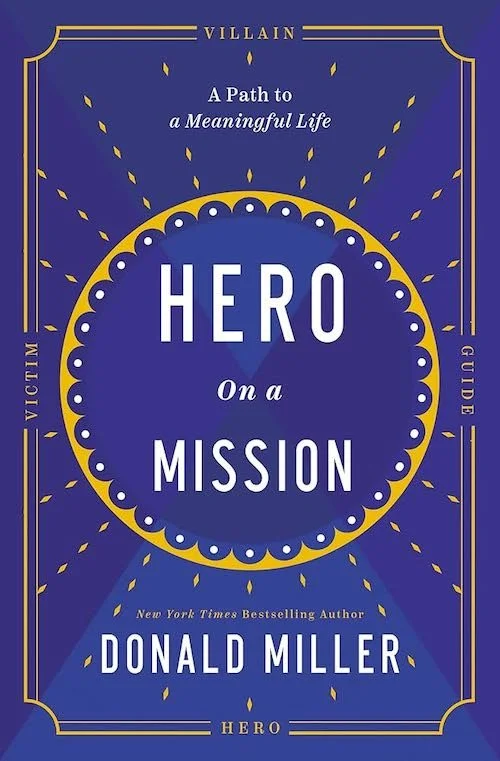
A book full of great insights and reminders is Hero on a Mission by Donald Miller.
BEFORE YOU GO
Three ideas in this week's newsletter—and at their core, they share a common idea.
The words we let in shape how we see the world. The books we read shape how we think about it. And the way we spend our days—our time, our attention, our conversations—shapes the life we actually live.
Eighteen years of borrowed time has taught me that none of it is accidental. The people who live well aren't just lucky. They're intentional.
I hope something this week gave you a reason to pause, to notice, or to choose a little more deliberately.
Stay inspired by the life you're living.
Kevin
Jan 22, 2026 — A Perfectly Logical Error
A story about a perfectly logical mistake, the limits of certainty, and why asking better questions may matter more than having the right answers.
Take Two
For people who know there’s more to life and don’t want to miss it.
A PERFECTLY LOGICAL ERROR
My dad once told me a story about growing up in Ireland during World War II.
Out of concern that the country might be invaded, many signs were stripped of their English, leaving only the Gaelic text. The idea was simple: make navigation harder for any invading force.
After the war ended, English signs were slow to return. Most of the time, this caused only minor confusion—until international travelers began passing through Shannon Airport.
The restroom doors were labeled only in Gaelic:
Fear — men
Maighdean — women
To travelers unfamiliar with the language, the reasoning seemed obvious. Fear starts with an F, so it must be female. Maighdean starts with an M, so it must be men.
Perfectly logical. Completely wrong.
People kept walking into the wrong restroom until airport officials finally added English translations.
The travelers weren’t thinking poorly—they were thinking clearly. Their logic worked. What failed was the information underneath it.
Life is full of moments like this. Times when our reasoning is sharp, our conclusions feel obvious, and yet we’re still heading for the wrong door.
Because logic is only as reliable as the understanding it’s built on.
We don’t usually go wrong because we aren’t thinking. We go wrong because we’re thinking from incomplete information—and treating it as if it’s complete.
So perhaps the quiet wisdom isn’t to distrust our thinking—but to hold it lightly enough to ask, What might I be missing here?
Sometimes the most important course correction isn’t a better answer, but a better question.
QUOTATIONS TO CONSIDER
“It is easier to see the mistakes in other people’s thinking than in our own.”
— Simone Weil, French philosopher
“The eye sees only what the mind is prepared to comprehend.”
— Henri Bergson, French philosopher
“It ain’t what you don’t know that gets you into trouble. It’s what you know for sure that just ain’t so.”
— Mark Twain, American writer and humorist
“The problem with the world is that the intelligent people are full of doubts, while the stupid ones are full of confidence.”
— Charles Bukowski, American poet and novelist
BOOK RECOMMENDATION
Same as Ever by Morgan Housel
At its core, Same as Ever is about human behavior. Housel explores the timeless forces that shape success, failure, progress, and frustration. Technology changes. Circumstances change. People don’t—at least not in the ways that matter most.
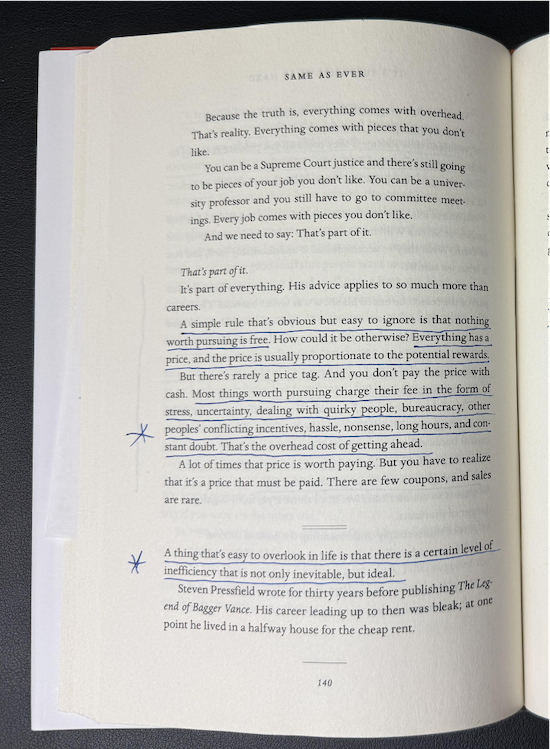
Same as Ever is a reminder that progress always comes with friction. Every meaningful pursuit has an “overhead cost”—stress, uncertainty, inefficiency, and inconvenience. The challenge isn’t eliminating these costs; it’s learning how much of them to accept so you can keep moving forward. Another great book from Morgan Housel. Check it out.
BEFORE YOU GO
This week, I’m focused on asking better questions—exploring what I might be missing—and remembering that a little inefficiency is part of the deal. I hope you find the right balance between progress and imperfection as you pursue the life you want.
Stay inspired by the life you’re living.
Kevin
Jan 15, 2026 — Sunshine and Shadows
We imagine a future version of life with fewer problems and more joy. But real happiness isn’t waiting somewhere else—it’s found in how we live, notice, and attend to life today.
Take Two
For people who know there’s more to life and don’t want to miss it.
WORDS TO WONDER
“If you think of your future self living in a new mansion, you imagine basking in splendor and everything feeling great. What’s easy to forget is that people in mansions can get the flu, have psoriasis, become embroiled in lawsuits, bicker with their spouses, feel wracked with insecurity and annoyed with politicians—which in any given moment can supersede any joy that comes from material success. Future fortunes are imagined in a vacuum, but reality is always lived with the good and bad taken together, competing for attention.”
— Morgan Housel
PERSPECTIVES TO PONDER
One of the most subtle ways we make ourselves unhappy is by comparing our full, lived reality to some imagined future.
We picture a future version of life with more perks and fewer problems than we have now. Our imagination makes it easy to believe we can have success without cost, happiness without interruption. But as Morgan Housel reminds us, those futures exist only in theory. Real life is never lived in a vacuum.
Every life (no matter how enviable it looks from the outside) is lived with a mix of beauty and burden. Joy shares space with inconvenience. Success coexists with insecurity. Love does not eliminate worry. Even the lives we most admire still include sickness, conflict, boredom, and doubt. That’s not failure—it’s simply what it means to be human.
The mistake isn’t wanting things to improve. Growth and progress matter. The mistake is believing that happiness lives somewhere else, that it will finally arrive once the variables line up just right. When we do that, we overlook the quiet goodness already woven into our days. We trade presence for projection.
A better way to live is to hold both perspectives at once. To acknowledge the hard without letting it eclipse the good. To pursue a better future without dismissing the life we’re already living. Not because it’s perfect, but because it’s real.
My future (and yours) will come with a mix of sunshine and shadows. It always does. But so does today. And if we’re paying attention, there is almost always something here, right now, worth noticing, appreciating, and enjoying.
QUOTATIONS TO CONSIDER
1. "Tend to the small things. More people are defeated by blisters than mountains."
— Kevin Kelly, founding executive editor Wired magazine (b. 1952)
2. "If we only wished to be happy, this could be easily accomplished; but we wish to be happier than other people, and this is always difficult, for we believe others to be happier than they are."
— Montesquieu, French judge, philosopher (1689-1755)
3. "People from a planet without flowers would think we must be mad with joy the whole time to have such things about us."
— Iris Murdoch, novelist and philosopher (1919-1999)
THE COMPLIMENT MOST PEOPLE NEVER GIVE
C. S. Lewis, the author of The Chronicles of Narnia, died on November 22, 1963, at the age of 64. His passing went largely unnoticed—not because his life was insignificant, but because that same day the world’s attention was consumed by the assassination of John F. Kennedy.
Lewis was buried near Oxford with only a few dozen people in attendance. At his funeral, his friend Austin Farrer offered a simple but striking tribute: “His characteristic attitude to people in general was one of consideration and respect. He paid you the compliment of attending to your words.”
When is the last time someone truly attended to your words?
We live in a distracted world where people attend to their phones more than they do people. The result? Half-heard conversations, eyes drawn elsewhere, attention divided and diluted. We may be physically present, but mentally we’re a hundred other places.
Leo Tolstoy once wrote, “The most important person is the one you are with in this moment.” Imagine what might change if we lived as if that were true. If we offered others the rare gift of undivided attention.
In a world starved for presence, attending to another’s words is no small thing. It is an act of respect. A form of generosity. And a quiet way to set yourself apart.
BEFORE YOU GO
We’re 15 days into 2026. If you repeated the past two weeks over and over for the rest of the year, would you be content with how you lived it?
Not every moment will be productive or wonderful. But I hope you’ve already made time to connect with people you care about, tried something you’ve never tried before, or created a memory you’ll enjoy revisiting for years to come.
Stay inspired by the life you’re living.
Kevin
Dec 11, 2025 — Is It a Wonderful Life?
A reflection on It’s a Wonderful Life, quiet meaning, and how seeing your life with new eyes can reveal more purpose than you realize.
Take Two
For people who know there’s more to life and don’t want to miss it.
WORDS TO WONDER
“The real voyage of discovery consists not in seeking new lands but in seeing with new eyes."
— Marcel Proust, novelist (1871-1922)
PERSPECTIVES TO PONDER
In the timeless film It’s a Wonderful Life, we meet George Bailey. He dreams of traveling the world and living a life of adventure—but he sacrifices those dreams to help others in his small town of Bedford Falls.
When a financial crisis strikes, George is on the verge of losing everything. He feels like a failure and even contemplates ending his life. That’s when he meets Clarence.
Clarence is an angel who shows George what Bedford Falls would have been like if he had never been born. It’s a dark and hopeless place, and the people he loves are suffering. Realizing how deeply he’s impacted others, George gains a new appreciation for his life.
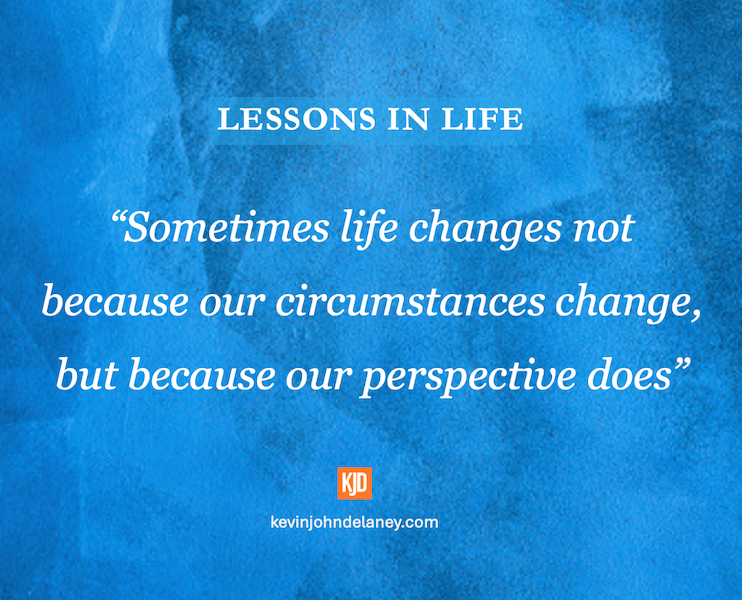
George’s external circumstances didn’t change. He’s still in the same town, facing the same struggles. But his perspective shifts dramatically. Instead of seeing himself as worthless, he now sees a life full of meaning and purpose.
I think we could all benefit from an encounter with someone like Clarence. We all have moments when we question our impact or wonder whether we’re making a difference. But sometimes, like George, we just need to see life from another point of view. A shift in perspective can help us realize our lives may be far better than we thought.
What if the life you’re living is already more meaningful than you realize? Maybe it’s not your life that needs to change—but the way you’re seeing it.
As we move through this holiday season, may we all find moments to see our lives with new eyes. And may you catch a fresh glimpse of the purpose your life carries—and a renewed appreciation for the many quiet ways you make the world better.
From my new book, Words to Wonder, #20 in the Perspective chapter.
REMINDERS WORTH REMEMBERING
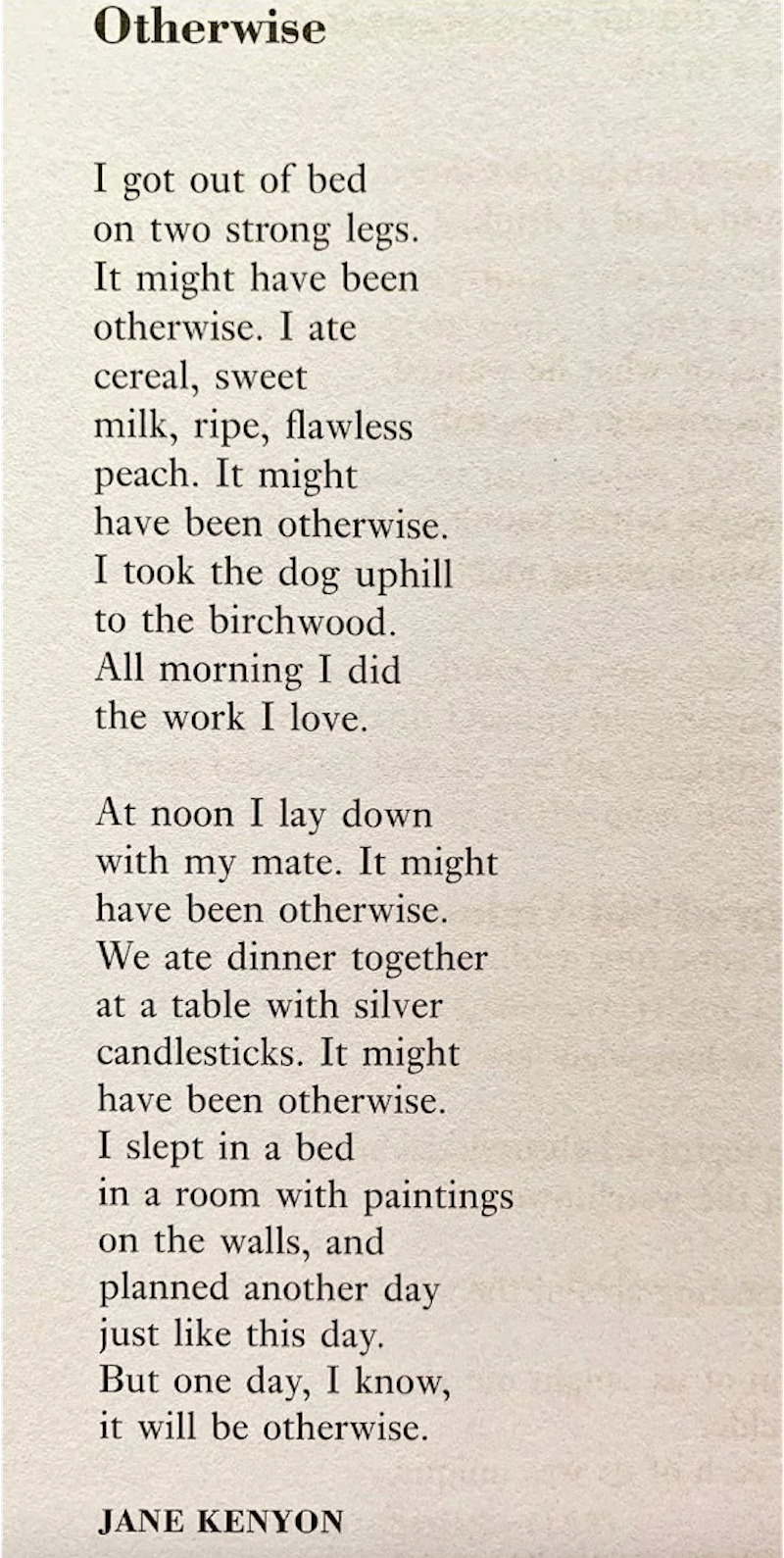
I’ve learned that the most meaningful lessons aren’t always new ones. More often, they’re things I already knew but simply lost track of in the busyness and noise of living—like an important note buried somewhere in a stack of papers on my desk. Then I stumble across it again and think, Oh right… this matters. And I move it back to the top where it can actually get the attention it deserves.
Jane Kenyon's poem, Otherwise, is one such reminder.
STORIES WORTH KNOWING
What Krispy Kreme Can Teach Us About Living a Better Life
We live in a world that equates speed with success. But sometimes the very thing we rush toward gets ruined in the process. This week I wrote about Krispy Kreme—a company whose dramatic rise holds an unexpected lesson for the rest of us.
It’s a story about donuts… but even more, it’s a story about how we move through our lives, and what we risk missing when we push too hard or too fast.
If you’ve ever felt the pressure to hurry, hustle, or do more, this short article may offer a fresh perspective.
Read the story HERE
BEFORE YOU GO
This week’s stories all point in the same direction. George Bailey reminds us that our lives may be far more meaningful than we realize. Jane Kenyon’s Otherwise nudges us to notice the ordinary gifts we usually rush past. And Krispy Kreme shows us what happens when “more” and “faster” start to ruin what was already good.
As this year winds down, maybe the challenge isn’t to do more, but to see more—to slow the pace, shift your perspective, and appreciate the life you’re already living.
Stay inspired by the life you’re living,
Kevin